

There is a version of the Grand Strand that nearly everyone recognizes immediately. It lives in memories of beach chairs lined along the shoreline, salt air drifting through open condo windows, and mornings that begin with the sound of waves before the rest of the house wakes up. It lives in family traditions—early walks through Cherry Grove, afternoons spent searching for shells, seafood dinners after sunset, and the familiar rhythm of summer returning year after year.
That version of the Grand Strand is real.
For generations, people have come here for rest, for family vacations, and for the simple pleasure of spending time beside the Atlantic Ocean. The beaches became famous because they offered something people wanted: a place to slow down.
Yet there is another Grand Strand that many people never see.
It exists beneath the vacation brochures and behind the oceanfront skyline. It is older, quieter, and far more connected to American history than most visitors realize. Long before beach houses and golf courses appeared along this coast, these waters and marshes had already witnessed centuries of change. Indigenous communities lived here thousands of years before European exploration. Pirates moved through hidden inlets and waterways. Revolutionary soldiers traveled across the region. Presidents rode through the area. Future lawmakers, military leaders, and historical figures left footprints along the same coast where visitors now spread beach towels every summer.
In many ways, the Grand Strand has been part of America’s story from the beginning.
As the United States approaches its 250th anniversary in 2026, communities across the country are revisiting the places and people that shaped the nation. Some locations are easy to identify. Cities such as Philadelphia, Boston, and Charleston naturally draw attention because of their well-known roles in American history.
The Grand Strand, however, often surprises people.
This coastline does not usually appear in conversations about the founding of the nation, yet its connections are remarkable.
Here are some of the historic sites worth visiting near North Myrtle Beach:
Conway
• Features a dedicated 2026 Revolutionary War exhibit
• Covers Horry County history from Indigenous communities through modern times
• Free admission
Vereen Memorial Historical Gardens
Little River
• Contains sections connected to the original King’s Highway route
• George Washington stayed at the nearby Vereen plantation on April 27, 1791
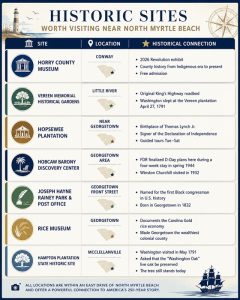
Hopsewee Plantation
Near Georgetown
• Birthplace of Thomas Lynch Jr., signer of the Declaration of Independence
• Guided tours available Tuesday–Saturday
Hobcaw Barony Discovery Center
Georgetown Area
• Franklin Roosevelt stayed here for four weeks during spring 1944
• D-Day planning was finalized during this period
• Winston Churchill visited in 1932
Joseph Hayne Rainey Park & Post Office
Georgetown Front Street
• Named for Joseph Hayne Rainey
• First Black man elected to the U.S. House of Representatives
• Born in Georgetown in 1832
Rice Museum
Georgetown
• Highlights the Carolina Gold rice economy
• Explains how Georgetown became the wealthiest colonial county
Hampton Plantation State Historic Site
McClellanville
• George Washington visited in May 1791
• Home to the historic “Washington Oak”
• The tree still stands today
• A signer of the Declaration of Independence was born nearby.
• The first Black man elected to the United States House of Representatives grew up here.
• George Washington traveled through this region and carefully documented his experience in his personal diary.
• Franklin Roosevelt spent time nearby while important World War II decisions were taking shape.
Even the roads many visitors drive today have roots reaching back into colonial America.
Most travelers pass these places without realizing what happened there.
That is understandable. History often becomes hidden when a location becomes known for something else. The Grand Strand eventually earned its reputation as a beach destination. Tourism transformed communities and reshaped the region’s identity. Over time, the stories that came before were pushed quietly into the background.
However, they never disappeared.
They remain woven into the names of towns, the outlines of old roads, and the communities that developed across the coast.
Take Kings Highway as an example. To many drivers, it is simply another road sign. Yet its origins stretch back to one of colonial America’s most important transportation routes. The King’s Highway connected major settlements along the East Coast and carried mail, commerce, travelers, and eventually news of revolution.
Or consider Windy Hill.
Today, people recognize it as one of the communities that later became North Myrtle Beach. Few realize its name traces back to George Washington’s journey through the region. According to local history, strong ocean winds repeatedly blew the future president’s hat from his head while he rode along the exposed coastline.
What seems ordinary today often has an extraordinary beginning.
Even farther south, Georgetown preserves another chapter of history. During the colonial era, rice plantations in the area generated tremendous wealth. At one point, Georgetown County became one of the wealthiest areas in the American colonies because of the Carolina Gold rice industry.
The waterways that later attracted visitors and fishermen once served very different purposes. Shallow channels and hidden inlets provided ideal hiding places for pirate ships and trading vessels moving along the Atlantic coast.
Long before tourists arrived, these shores were places of strategy, commerce, conflict, and survival.
America’s 250th anniversary creates an opportunity to look beyond the beach and rediscover those stories.
Because beneath the familiar vacation destination is another landscape entirely—a place where history unfolded over five centuries and where the events that shaped the country often happened much closer than people realize.
The Grand Strand may be known for the ocean.
But it has always been part of something much larger.
Planning your next stay along the Grand Strand? Let JL Beach Ventures help you experience more than just the beach. Choose from comfortable, well-located beach vacation rentals that place you close to both the shoreline and the rich history woven throughout the coast. Book your stay today and turn your visit into something far more memorable.
JL Beach Ventures
612 39th Ave S
North Myrtle Beach, SC 29582
(570) 499-4000
https://northmyrtlebeachscvacationrentals.com
Areas Served: